Overview
About Letaba Elephant Hall
Why stop
- Real tusks make the Magnificent Seven stories tangible.
Map
Where it is
The highest, rockiest slopes around here are a summer buffet for grizzly bears.
Kruger Tour Guide
Your drive to Letaba Elephant Hall, narrated.
Parkwolf is a GPS audio tour guide for Kruger National Park. As you drive, it chimes in with what’s ahead: hidden gems, upcoming stops, history, geology, and wildlife, right through your car’s speakers.
See the Kruger audio tourRecorded for this place
Letaba Elephant Hall: Meet the Big Tuskers“You're coming up on Letaba Rest Camp, home to Elephant Hall. I'd stop for the museum even if you're not staying overnight: its real tusks give you a close look at the size of Kruger's famous big tuskers.”
Plays as you drive up to Letaba Elephant Hall in the Parkwolf Kruger Tour Guide.
More stories near here in the app
- The Fruit Bat's Shoulder Display
- The Skimmer’s Uneven Bill
- Matambeni Bird Hide: Birds Along the Letaba
- The Openbill's Snail Tool
- 298 audio storiesacross Kruger’s roads, triggered by GPS as you drive
- Wildlife heatmapsfor Lion, Leopard, Elephant, and 13 more
- Works offlinemaps, 3 trails, 129 places, and audio download before you lose signal
- CarPlay readysimple controls built for the drive
“Fantastic app with many points of information… It’s great to just turn on while you’re driving and it gives you an audio tour of the national Park. We love it!!!!”


Guide
More about Letaba Elephant Hall
Meet the big tuskersLetaba Elephant Hall is a dedicated elephant museum inside Letaba Rest Camp.
Letaba Elephant Hall is a dedicated elephant museum inside Letaba Rest Camp. Its indoor exhibits explore elephant biology and anatomy, with real tusks from Kruger's best-known big tuskers. If you're already stopping at Letaba, it's a worthwhile change of pace from wildlife viewing: come for a focused museum visit, not a full day indoors.
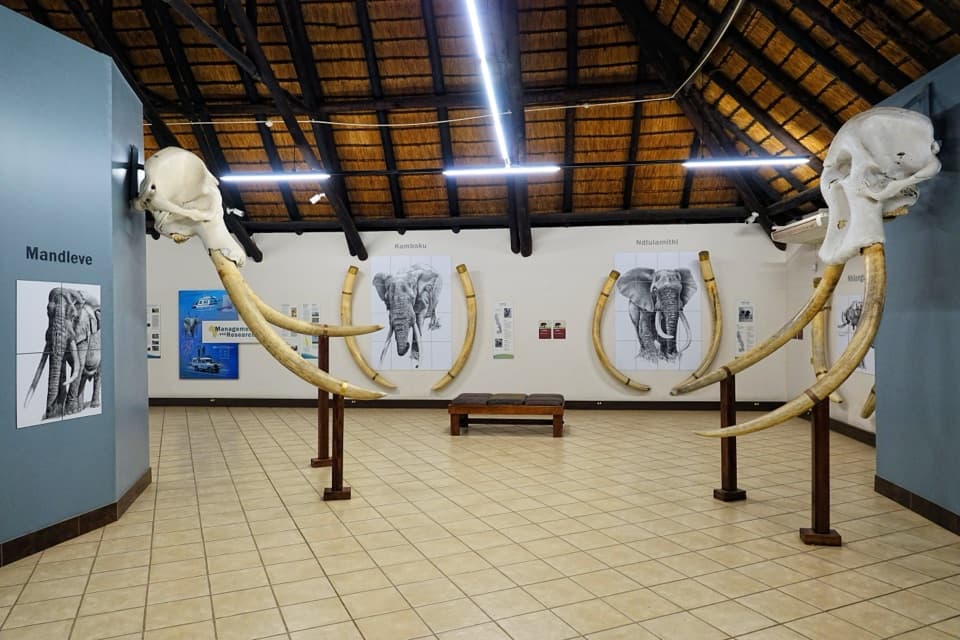
Six of the Magnificent SevenThe hall holds tusks from Dzombo, Kambaku, Mafunyane, Ndlulamithi, Shawu and Shingwedzi—six of…
The hall holds tusks from Dzombo, Kambaku, Mafunyane, Ndlulamithi, Shawu and Shingwedzi—six of the seven bulls SANParks made famous as the Magnificent Seven. Comparing the real tusks and following the stories attached to individual elephants is the main draw. Visitors often praise the learning displays and the chance to see the tusks up close.
How the name spreadKruger's chief warden, Dr U de V Pienaar, launched the Magnificent Seven campaign in 1980 to…
Kruger's chief warden, Dr U de V Pienaar, launched the Magnificent Seven campaign in 1980 to publicize the bulls as a conservation success. Wildlife artist Paul Bosman painted them, and researcher Dr Anthony Hall-Martin wrote illustrated articles. Pienaar borrowed the group's name from the 1960 Hollywood film.
Shawu and JoãoShawu's tusks were recorded at 3.17 metres long.
Shawu's tusks were recorded at 3.17 metres long. João, the seventh bull often associated with the group, isn't represented in the hall: he broke both tusks near the lip around 1984, and the pieces were never found.
Pair it with LetabaThe hall is inside Letaba Rest Camp, near the camp restaurant, cafeteria, shop and day-visitor…
The hall is inside Letaba Rest Camp, near the camp restaurant, cafeteria, shop and day-visitor picnic area between the hall and E-circle. Letaba is about 51 km from Phalaborwa Gate; allow roughly two hours for that drive before wildlife stops. The hall's current hours aren't confirmed, so check before making a special detour.
Wildlife
Wildlife in Kruger
 1,378 sightingsLionMost seen around 6 AMSighting map
 779 sightingsLeopardMost seen around 5 AMSighting map
 2,515 sightingsElephantMost seen around 5 PMSighting map
 449 sightingsWhite RhinocerosMost seen around 6 AMSighting map
 583 sightingsBuffaloMost seen around 5 PMSighting map
 521 sightingsWild DogMost seen around 6 AMSighting map
Sighting maps show where each species has been reported across Kruger. Wildlife moves, so no sighting is guaranteed.